As Maryland reopened its economy mid-pandemic, returning to work and social life was full of uncertainty. CIAT — the Covid-19 Information and Tracker — is a user-centered app concept that gives Marylanders the health updates, supply locations, and local infection data they need to make safer everyday decisions.
Reopening a state, one uncertain decision at a time.
Between March and April, nearly 21,000 workers lost their jobs in Maryland because of the pandemic. While millions were asked to work from home, many people still had to be physically present at their workplaces.
As the state moved to reopen its economy, a clear need emerged: a tool that could help people return to work and social interaction safely — turning scattered, anxiety-inducing COVID information into clear cues for everyday decisions.
How might we help Marylanders return to work and social life with confidence, not anxiety?
Research
From a brainstorm to a grounded direction.
The team began by brainstorming concepts, then committed to research problem #5: an app to enable a safe return to work and social interaction. From there, real users shaped the direction.
1
Concept & consensus
Brainstormed concepts and aligned the team on a single goal — safe return to work and social interaction.
2
Semi-structured interviews
Interviewed 14 users — 13 living in Maryland and 1 in Texas — to understand their pandemic concerns and needs.
3
Data analysis
Analysed the interview data across all 14 participants to surface shared needs and pain points.
4
Feature generation
Generated app features grounded in the research and anchored to the team's goal for CIAT.
14Users interviewed
13Maryland residents
#5Research problem chosen
UCDUser-centered approach
Design process
Designed with users, tested with users, refined with users.
With the research in hand, we moved from early paper app screens to digital wireframes to tested, iterated prototypes — keeping users in the loop at every step.
Early app-screen concepts — from paper to digital
Personas
Synthesised research into personas to keep design decisions tied to real Marylanders' needs.
Wireframing
Built the app's structure and screens in Whimsical.
Prototyping
Brought interfaces to life and tested them with InVision.
Usability & A/B testing
Created user tasks and scenarios, then ran usability and A/B testing over Zoom.
Iteration
Refined the wireframes through several rounds based on user suggestions.
Build
Coded the wireframes we were able to, moving the concept toward a working product.
Whimsical InVision Zoom HTML/CSS
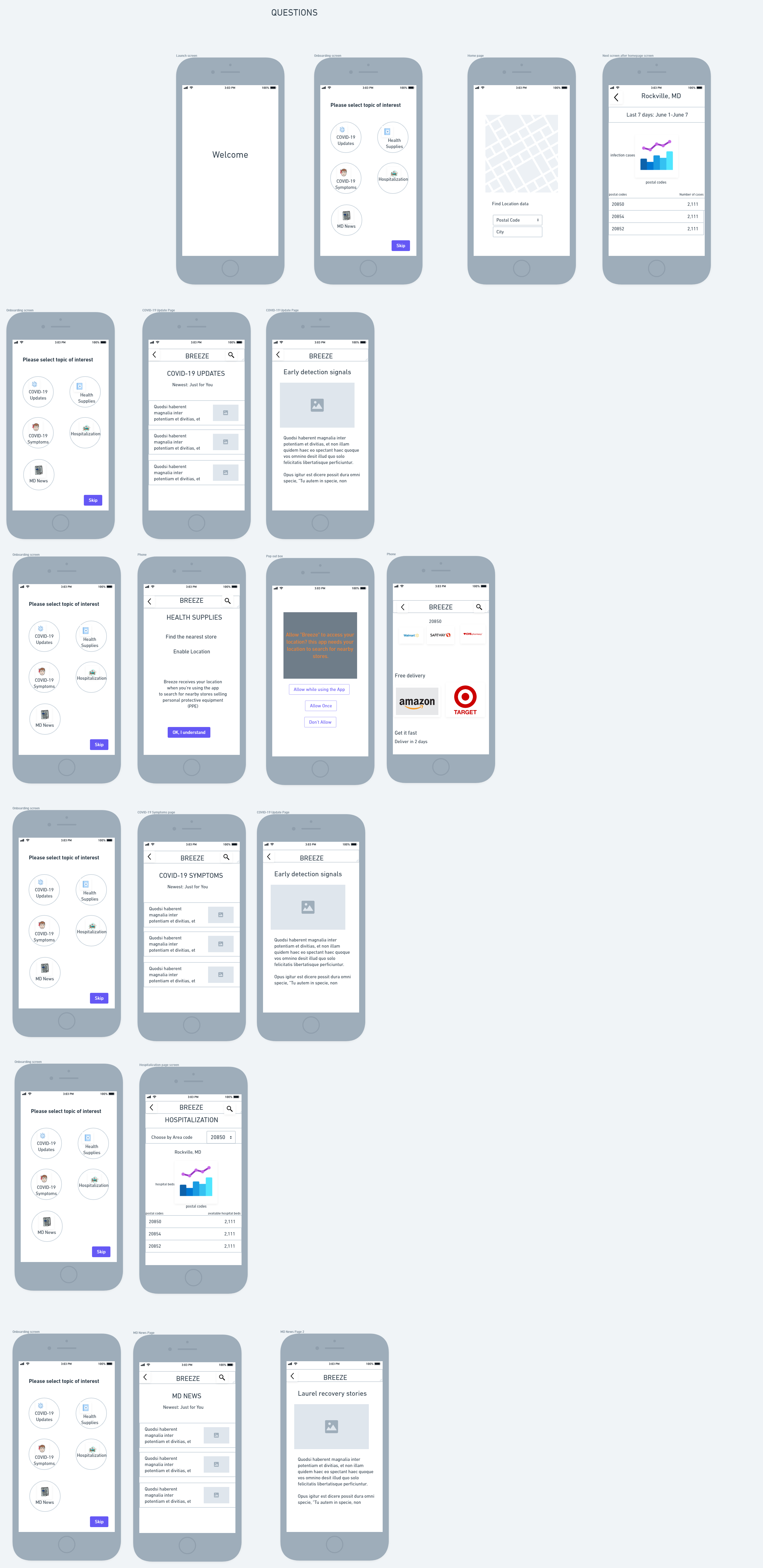
Wireframe walkthrough — the CIAT prototype in motion
Developing the CIAT app from wireframes
About CIAT
One app for the questions COVID kept raising.
Covid-19 Information and Tracker (CIAT) answers the many uncertainties of the pandemic — built specifically for Marylanders, and shaped by the features users themselves asked for.
Health updates
Timely, trustworthy COVID-19 health information in one place.
Health-supplies locator
Find where essential health supplies are available nearby.
Local infection rates
Visualised infection data across Maryland cities and postal codes.
What makes CIAT distinct is its focus: it's tailored for Marylanders, offering concrete cues on how to safely return to social interaction and work. Built on a user-centered design approach, it was implemented around the features and functionality its users said they needed.
Reflection
The takeaway.
CIAT shows how user-centered design can turn a moment of public anxiety into a focused, usable tool — by listening to a community and building only what it actually needs.
What I'd do next
The natural next step is to finish building the remaining screens, then run a larger round of usability testing across Maryland's regions to validate the infection-data visualisations and supply locator with a more representative group of residents.
.jpg)
.jpg)
.jpg)